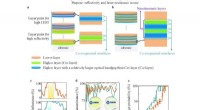
1. Refraction: This is the bending of waves as they pass from one medium to another. The change in speed of the wave causes it to change direction. This is why a straw in a glass of water appears to be bent.
2. Reflection: This is the bouncing back of waves when they encounter a boundary between two media. The angle of incidence (the angle at which the wave hits the boundary) is equal to the angle of reflection (the angle at which the wave bounces back).
3. Transmission: This is the passing of waves through a boundary between two media. Some of the wave's energy may be absorbed by the new medium, but some will continue to propagate.
4. Change in Speed: The speed of a wave is determined by the properties of the medium it is traveling through. For example, light travels faster in air than it does in water. When a wave moves from one medium to another, its speed changes.
5. Change in Wavelength: The wavelength of a wave is the distance between two successive crests or troughs. When a wave's speed changes, its wavelength also changes. This is because the frequency of the wave remains constant.
Examples:
* Light: When light passes from air to water, it slows down and bends. This causes refraction, which is why objects appear to be in different positions when viewed through water.
* Sound: When sound waves pass from air to a solid, they slow down. This is why a sound wave can be heard louder when you put your ear to a door.
* Water waves: When water waves pass from deep water to shallow water, they slow down and their wavelengths decrease. This causes them to bend and sometimes break.
Factors affecting the behavior of waves at the boundary:
* The properties of the two media: The density, elasticity, and temperature of the media affect the speed of the wave.
* The angle of incidence: The angle at which the wave hits the boundary affects how much of the wave is reflected, refracted, and transmitted.
Overall, the behavior of waves at a boundary between two media is complex and depends on several factors. Understanding these principles helps us understand how light, sound, and other waves behave in different environments.