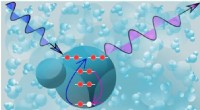
The Photoelectric Effect
* The Experiment: Shine light on a metal surface. If the light has enough energy, electrons are ejected from the metal.
* The Problem: Classical wave theory predicted that light's intensity should determine how many electrons are ejected, and that any frequency of light should eventually be able to eject electrons.
* Einstein's Solution (1905): Light behaves as if it's made of tiny packets of energy called photons. The energy of a photon is proportional to the frequency of light (E = hf, where E is energy, h is Planck's constant, and f is frequency).
* Key Observation: The *frequency* of the light determines whether electrons are ejected, not the intensity. This is because the energy of a photon is directly related to its frequency. Only photons with enough energy to overcome the metal's "work function" (the energy required to release an electron) can eject electrons.
Other Evidence for Light as Particles:
* Compton Scattering: X-rays scatter off electrons, and the scattered X-rays have a longer wavelength than the incident X-rays. This can be explained by considering the X-ray photons as particles that collide with the electrons.
* Blackbody Radiation: This phenomenon describes the electromagnetic radiation emitted by a heated object. Classical physics failed to explain the shape of the blackbody spectrum, but Planck successfully explained it by assuming that the energy of the emitted radiation was quantized, meaning it existed in discrete packets.
* Pair Production: High-energy photons can convert into an electron and a positron (an anti-electron). This demonstrates that energy can be converted into matter, further supporting the particle nature of light.
Wave-Particle Duality
It's important to note that light doesn't always behave like a stream of particles, nor does it always behave like a wave. Light exhibits both particle-like and wave-like properties, a concept called wave-particle duality. This is a fundamental principle in quantum mechanics.
Think of it like this:
Light is like a chameleon, changing its "appearance" depending on the situation. Sometimes it acts like a wave, sometimes it acts like a particle. It's not one or the other; it's both at the same time.