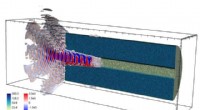
1. Transverse Waves:
* Particle motion: The particles in the medium oscillate perpendicular to the direction the wave travels.
* Example: Light waves, waves on a string, ripples on water.
2. Longitudinal Waves:
* Particle motion: The particles in the medium oscillate parallel to the direction the wave travels.
* Example: Sound waves, compression waves in a spring.
3. Surface Waves:
* Particle motion: A combination of transverse and longitudinal motion. Particles move in a circular or elliptical path.
* Example: Ocean waves.
Important Note: These classifications are based on the *medium* the wave travels through. Some waves, like electromagnetic waves (including light), don't require a medium and can travel through a vacuum.
Let me know if you'd like a more detailed explanation of any of these wave types!