Transverse Waves in Solids:
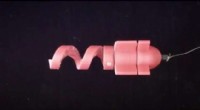
* Example: Waves on a stretched string or a spring
* How it works: The particles of the solid oscillate perpendicular to the direction the wave travels. The wave is a disturbance in the elastic properties of the solid.
Transverse Waves in Liquids:
* Example: Surface waves on water
* How it works: The wave travels along the surface of the liquid, with particles moving in a circular or elliptical motion. The restoring force is due to gravity and surface tension.
Transverse Waves in Gases:
* Example: Light waves (electromagnetic waves)
* How it works: The wave is a disturbance in the electric and magnetic fields, and the particles themselves don't move. The waves are oscillating perpendicular to the direction of propagation.
Important Note:
While transverse waves can exist in solids and liquids, they don't typically travel long distances in liquids due to damping forces. The surface waves in liquids are more of a combination of transverse and longitudinal motion.
Summary:
* Solids: Vibrations in the medium
* Liquids: Surface waves with a combination of motion
* Gases: Electromagnetic waves (no particle movement)