Key Concepts:
* Gauge Group: QCD uses the SU(3) gauge group, which means the theory has 8 independent gauge bosons (gluons).
* Fundamental Fields: It involves quarks (fermions) and gluons (bosons).
* Lagrangian Density: The fundamental equations of QCD are derived from a Lagrangian density, which includes terms for:
* Kinetic energy of quarks and gluons
* Interactions between quarks and gluons (mediated by the strong force)
* Self-interactions between gluons
* Color Charge: Quarks carry a property called "color charge," analogous to electric charge. There are three "colors" (red, green, blue) and their anti-colors. Gluons also carry color charge.
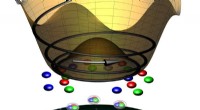
* Confinement: One of the central features of QCD is color confinement, where quarks are always bound together in groups called hadrons (e.g., protons, neutrons). Free quarks have never been observed experimentally.
Mathematical Formalism:
* Lagrangian Density:
* The Lagrangian density for QCD is quite complex, but it can be written as:
```
L = -1/4 F^a_{\mu\nu}F^{a\mu\nu} + \bar{\psi}(i\gamma^\mu D_\mu - m)\psi
```
* Where:
* F is the field strength tensor for gluons
* a is the color index
* ψ is the quark field
* D is the covariant derivative (incorporating the interaction with gluons)
* m is the quark mass
* Path Integral Formulation: QCD calculations often use the path integral formulation, which involves integrating over all possible configurations of quark and gluon fields.
* Perturbation Theory: For some processes, perturbation theory can be used to calculate results. This involves expanding the Lagrangian and calculating higher-order corrections.
* Lattice Gauge Theory: Due to the complexity of QCD, numerical simulations are often used. Lattice gauge theory approximates space-time as a discrete lattice and then solves the QCD equations numerically.
Key Features:
* Asymptotic Freedom: At high energies, quarks interact weakly. This property, called asymptotic freedom, allows for perturbative calculations.
* Non-Perturbative Behavior: At low energies, the strong force becomes very strong, leading to non-perturbative behavior and confinement.
Challenges:
* Confinement: Mathematically proving color confinement remains a major challenge in theoretical physics.
* Non-Perturbative Calculations: Many aspects of QCD require non-perturbative approaches, which are computationally expensive.
In summary, QCD is a very complex and challenging theory, but it provides a powerful framework for understanding the strong force and the behavior of quarks and gluons. Its mathematical formalism involves advanced techniques from quantum field theory, gauge theory, and numerical simulations.