Here's a breakdown:
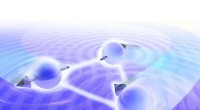
* Wave: A disturbance that travels through a medium or space, transferring energy without transferring matter.
* Particles: The individual components of the medium through which the wave travels.
* Rest position: The equilibrium position of a particle when there is no wave disturbance.
* Amplitude: The maximum displacement of a particle from its rest position as the wave passes through.
Think of it this way:
Imagine a rope tied to a wall. If you shake the rope up and down, you create a wave that travels along the rope. The particles of the rope move up and down, but they don't actually travel along the rope with the wave. The distance each particle moves up and down from its original position is the amplitude of the wave.
Important Note: The amplitude is a key property of a wave because it determines the wave's energy. The higher the amplitude, the more energy the wave carries.