* Photons are massless: Unlike particles with mass, photons always travel at the speed of light in a vacuum. This means their velocity cannot be increased.
* Energy and momentum relationship: A photon's momentum is directly proportional to its energy (p = E/c, where p is momentum, E is energy, and c is the speed of light).
* No change in velocity, only energy: To increase a photon's momentum, you must increase its energy. This can be done by shifting it to a higher frequency (e.g., blue light has higher energy than red light).
So, how do you change a photon's energy (and therefore momentum)?
* The Doppler Effect: If the source of the photon is moving towards you, the light you observe will be blueshifted, meaning it will have a higher frequency and higher energy (and therefore momentum). Similarly, if the source is moving away from you, the light will be redshifted, lowering its energy and momentum.
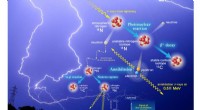
* Scattering: When a photon interacts with matter, it can scatter, changing its direction and energy. This is seen in phenomena like the Compton effect.
* Absorption and Emission: A photon can be absorbed by an atom or molecule, and a new photon with different energy can be emitted.
In summary, you can't directly "increase" a photon's momentum, but you can change its energy, which in turn affects its momentum.