Reflection:
* What happens: The wave bounces back from the surface at an angle equal to the angle of incidence.
* Example: Light reflecting off a mirror, sound waves bouncing off a wall.
* Factors: The smoothness of the surface plays a significant role. A perfectly smooth surface will reflect the wave in a single direction, while a rough surface will scatter the wave in many directions.
Refraction:
* What happens: The wave changes direction as it passes from one medium to another (e.g., from air to water). This occurs because the wave travels at different speeds in different mediums.
* Example: Light bending as it enters water, causing a straw to appear broken.
* Factors: The angle of incidence, the speed of the wave in each medium, and the densities of the mediums all influence the amount of refraction.
Diffraction:
* What happens: The wave bends around an obstacle or spreads out through an opening.
* Example: Light spreading out after passing through a narrow slit, sound waves bending around corners.
* Factors: The size of the obstacle or opening relative to the wavelength of the wave determines how much diffraction occurs. Shorter wavelengths diffract less.
Absorption:
* What happens: The surface absorbs the energy of the wave, converting it into another form, such as heat.
* Example: Microwaves being absorbed by food, sound waves being absorbed by a soft material.
* Factors: The material of the surface determines how much energy it absorbs.
Transmission:
* What happens: The wave passes through the surface.
* Example: Light passing through a window, sound waves passing through a door.
* Factors: The transparency of the surface determines how much of the wave is transmitted.
Interference:
* What happens: Two or more waves interact with each other, creating a pattern of reinforcement (constructive interference) or cancellation (destructive interference).
* Example: Two waves of light overlapping to create a brighter or darker spot.
* Factors: The wavelength, frequency, and phase of the waves determine the interference pattern.
Other phenomena:
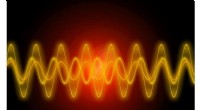
* Standing Waves: Occurs when two waves of the same frequency and amplitude travel in opposite directions and interfere, creating a stationary wave pattern.
* Doppler Effect: The change in frequency of a wave due to the motion of the source or observer.
Key Points to Remember:
* The behavior of a wave depends on its properties (frequency, wavelength, amplitude) and the properties of the surface (material, texture, size).
* Multiple phenomena can happen simultaneously, and the relative prominence of each depends on the specific situation.
Understanding these concepts helps us interpret the behavior of various wave phenomena in our daily lives, from light and sound to radio waves and seismic waves.