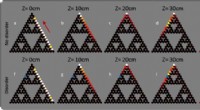
Wave Fronts
* Definition: A wave front is a surface that represents all points in space that have the same phase of a wave at a given instant in time.
* Visualization: Imagine a pebble dropped in a still pond. The expanding circles of ripples represent wave fronts.
* Key Characteristics:
* Wave fronts are surfaces, not lines.
* They are perpendicular to the direction of wave propagation.
* They represent the "crest" or "trough" of the wave at a specific moment.
Rays
* Definition: A ray is a line that indicates the direction of energy propagation of a wave.
* Visualization: Imagine a single straight line drawn from the center of the ripple outwards.
* Key Characteristics:
* Rays are lines, not surfaces.
* They are tangential to the wave front.
* They represent the path of energy flow.
Relationship
* Orthogonality: Wave fronts and rays are always perpendicular to each other. This means the direction of wave propagation is always perpendicular to the surface of the wave front.
* Representation: Wave fronts provide a more complete picture of the wave's behavior, especially in complex situations like diffraction or interference. Rays are a simpler way to represent wave direction.
Analogy
Think of a marching band.
* Wave fronts: Imagine the lines of marching band members, which represent points in the same phase of the wave.
* Rays: The direction the band marches (forward) would represent the rays. The lines of band members are perpendicular to the marching direction.
In Summary
* Wave fronts are surfaces that represent the phase of a wave at a specific instant in time.
* Rays are lines that indicate the direction of energy propagation.
Let me know if you have any other questions!