Here's the breakdown:
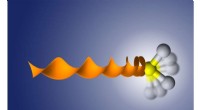
* Light acts like a wave: This is the classic view, and it explains phenomena like diffraction (light bending around corners) and interference (light waves canceling each other out). We see evidence of this in everyday life, like the rainbow colors created by a prism or the shimmering of light on water.
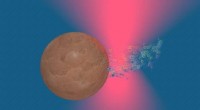
* Light acts like a particle: This is a more modern understanding, and it explains phenomena like the photoelectric effect (where light can knock electrons off of a metal surface). In this case, we think of light as being made up of tiny packets of energy called photons.
So, the answer is yes and no! Light exhibits both wave-like and particle-like behavior depending on the situation. This duality is a fundamental concept in quantum mechanics and a testament to the strangeness and beauty of the universe.
Here's a simple analogy: Imagine you throw a stone into a pond. You see ripples spread outwards – that's wave-like behavior. But, the stone itself is also a particle that traveled through the air and impacted the water.
Think of light as acting similarly – it can exhibit both wave-like characteristics and particle-like characteristics, depending on how you interact with it and what you're trying to understand.