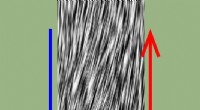
* Wave Direction: The wave itself moves horizontally (or in whatever direction the wave is propagating).
* Particle Motion: The individual particles in the medium (like water molecules or points on a rope) move up and down (or in whatever direction is perpendicular to the wave's direction).
Think of it like this:
* Imagine a rope tied to a wall. If you shake the end of the rope up and down, you create a wave that travels along the rope.
* The wave itself moves horizontally, but the individual points on the rope move vertically.
Key Characteristics:
* Crest: The highest point of the wave.
* Trough: The lowest point of the wave.
* Amplitude: The maximum displacement of a particle from its rest position.
* Wavelength: The distance between two consecutive crests or troughs.
* Frequency: The number of waves passing a point per second.
Examples of Transverse Waves:
* Light waves: These are electromagnetic waves that travel at the speed of light. The electric and magnetic fields oscillate perpendicular to the direction of wave propagation.
* Waves on a string: Like the example with the rope, these waves involve the up-and-down motion of particles.
* Water waves: Although water waves are a bit more complex, the individual water molecules mostly move in a circular motion, with a vertical component that resembles a transverse wave.
Let me know if you'd like more details or have any other questions!