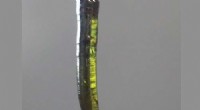
A bimetallic strip is a composite piece of metal made of two different metals with different coefficients of thermal expansion. This means that each metal expands or contracts at a different rate when heated or cooled.
Here's how it works:
1. Construction: The strip is made by bonding two strips of different metals, usually brass and steel, side-by-side. Brass has a higher coefficient of thermal expansion than steel.
2. Heating: When the strip is heated, the brass side expands more than the steel side. This creates a bending motion in the strip, with the brass side expanding outward.
3. Cooling: When the strip is cooled, the brass side contracts more than the steel side. This results in the strip bending in the opposite direction, with the steel side now expanding outward.
4. Application: This bending motion is the key to how bimetallic strips are used. The bending can trigger various mechanical actions, like:
* Thermostats: Used in ovens, refrigerators, and other devices to control temperature.
* Circuit breakers: Used in electrical systems to break the circuit when excessive current flows.
* Fire alarms: Used to trigger the alarm when the temperature reaches a certain point.
* Temperature sensors: Used to measure temperature changes in various applications.
In summary: A bimetallic strip utilizes the different expansion rates of its constituent metals to create a bending motion that can be used for temperature control, protection, and sensing.