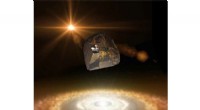
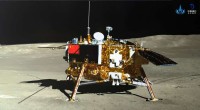
* Initial Launch: The probe is launched from Earth with a powerful rocket that imparts a huge amount of initial velocity.
* Inertia: Once in space, the probe continues moving in a straight line at a constant speed due to inertia (Newton's first law of motion). This means it keeps moving in the same direction and at the same speed unless acted upon by a force.
* Gravity: While inertia wants the probe to move in a straight line, gravity from celestial bodies (like the Sun, planets, or even moons) pulls on it, changing its direction and speed. This is why probes can be put into orbit or slingshot around planets to gain speed.
* Maneuvering Thrusters: Space probes often have small thrusters for course corrections and maneuvering. These are used to adjust the probe's trajectory and to slow it down or speed it up.
* Solar Sails: Some probes use solar sails which are large reflective surfaces that are propelled by the pressure of sunlight.
In summary:
* Initial launch: The starting push.
* Inertia: Keeps it moving without slowing down.
* Gravity: Shapes its path and can be used to gain speed.
* Maneuvering thrusters: Fine-tune its trajectory and speed.
* Solar sails: Can be used for propulsion by sunlight pressure.