Here's a breakdown:
* Temperature: The average speed of particles is directly related to the temperature of the substance. Higher temperatures mean faster average speeds.
* Molecular mass: Heavier particles (higher molecular mass) move slower than lighter particles at the same temperature.
* State of matter: Particles in a solid move slower than particles in a liquid, which move slower than particles in a gas.
To get a better understanding of particle speeds, here are some key concepts:
* Root-mean-square speed (vrms): This is a common way to express the average speed of particles. It is calculated as the square root of the average of the squared speeds of all the particles.
* Most probable speed: This is the speed at which the maximum number of particles are moving.
* Average speed: This is the arithmetic average of the speeds of all the particles.
Formulas:
* vrms = √(3kT/m), where:
* k is the Boltzmann constant (1.38 x 10^-23 J/K)
* T is the absolute temperature in Kelvin
* m is the mass of one particle in kg
Example:
Let's say we have a gas of nitrogen molecules (N2) at room temperature (298 K). Using the formula for vrms, we can calculate:
* vrms = √(3 * 1.38 x 10^-23 J/K * 298 K / (28 x 1.66 x 10^-27 kg)) ≈ 515 m/s
This means that the average speed of nitrogen molecules at room temperature is approximately 515 meters per second.
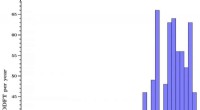
Remember: The Maxwell-Boltzmann distribution shows that there is a range of speeds, not just one average speed. Some particles move much slower, while others move much faster.