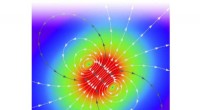
* Directly proportional to the product of their charges: The stronger the charges, the stronger the force.
* Inversely proportional to the square of the distance between their centers: This means that as the distance between the charges increases, the electric force decreases rapidly.
Here's how the distance affects the electric force:
* Double the distance: The force becomes one-fourth its original strength.
* Triple the distance: The force becomes one-ninth its original strength.
* Halve the distance: The force becomes four times stronger.
* Reduce the distance to one-third: The force becomes nine times stronger.
Mathematical representation:
Coulomb's Law is represented by the following equation:
```
F = k * (q1 * q2) / r^2
```
Where:
* F is the electric force between the charges
* k is Coulomb's constant (approximately 8.98755 × 10^9 N⋅m^2/C^2)
* q1 and q2 are the magnitudes of the charges
* r is the distance between the centers of the charges
Key takeaway: The electric force is inversely proportional to the square of the distance. This means that a small change in distance can have a significant impact on the strength of the electric force.