On a large scale:
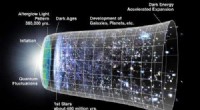
* Formation and evolution of stars and planets: Gravity pulls together clouds of gas and dust, forming stars and planets. It also governs the movements of celestial bodies within solar systems, galaxies, and clusters.
* Tides: The gravitational pull of the Moon and Sun on Earth's oceans causes tides.
* Shape of the Earth: Gravity pulls all the Earth's mass towards its center, giving it an oblate spheroid shape (slightly flattened at the poles and bulging at the equator).
On a smaller scale:
* Our weight: The force of gravity pulls us towards the Earth, giving us weight.
* Objects falling to the ground: When you drop something, gravity accelerates it towards the Earth.
* Holding the atmosphere: Gravity keeps the Earth's atmosphere from escaping into space.
Other important points:
* Universal law: Gravity is a universal force, meaning it affects every object with mass in the universe.
* Strength: The strength of gravity depends on the masses of the objects involved and the distance between them. Larger masses and closer distances result in stronger gravitational forces.
* Relativity: Einstein's theory of General Relativity shows that gravity is not just a force but a warping of spacetime caused by mass and energy.
In essence, gravity is the fundamental force responsible for shaping the universe, from the smallest particles to the largest structures.