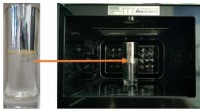
However, you can demonstrate the mechanical nature of sound through a simple experiment that shows how it requires a medium to travel. Here's how:
Experiment:
1. Materials: A bell, a glass jar, a vacuum pump (optional).
2. Procedure:
* Ring the bell in the air. You can hear it clearly.
* Place the bell inside the glass jar. Ring the bell again. You can still hear it.
* If you have a vacuum pump, pump out the air from the jar as much as possible. Ring the bell again. You will hear the sound become much quieter, or even disappear completely.
Explanation:
* Sound is a mechanical wave, meaning it requires a medium (like air, water, or solids) to travel.
* In the first step, sound waves travel through the air to your ears.
* In the second step, the sound waves still travel through the air inside the jar.
* In the third step, by removing most of the air from the jar, you remove the medium for sound to travel through. Since sound is a mechanical wave, it can't travel through a vacuum.
Conclusion:
This experiment demonstrates that sound needs a medium to travel, supporting the idea that sound is a mechanical wave. While it doesn't directly prove the mechanical nature of sound, it provides strong evidence for it.
Note: This experiment is a simplified demonstration. In reality, there will still be a small amount of air left in the jar, and sound can travel very faintly through other mediums like glass. However, the significant reduction in sound volume when the air is removed clearly shows the dependence of sound on a medium.