1. Lack of an Absolute Reference Frame:
* No way to define "at rest": There is no fixed point in the universe that can be considered truly stationary, making it impossible to determine absolute motion. Any measurement of motion is relative to some other object or frame of reference.
* Invariance of physical laws: The laws of physics should hold true regardless of the observer's motion, implying that there is no privileged frame of reference.
2. The Relativity of Motion:
* Relative motion: All motion is relative to an observer. If two objects are moving at different speeds, an observer on one object will perceive the other object as moving, while an observer on the other object will perceive the first object as moving.
* No absolute velocity: There is no way to determine an object's absolute velocity, only its velocity relative to another object.
3. The Michelson-Morley Experiment:
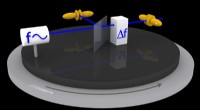
* Attempt to detect luminiferous ether: This experiment, designed to detect the hypothetical medium carrying light waves, failed to find evidence of an absolute reference frame.
* Challenging the concept of ether: The experiment's results strongly suggested that light does not require a medium to propagate and challenged the notion of an absolute reference frame.
4. The Principle of Relativity:
* Einstein's contribution: Albert Einstein formulated the special theory of relativity, which stated that the laws of physics are the same for all observers in uniform motion. This principle directly addressed the problem of absolute motion.
* Consequences of relativity: The theory introduced concepts like time dilation, length contraction, and the speed of light being constant for all observers, challenging the classical notions of space and time.
In summary, the concept of absolute motion in classical physics poses problems due to the lack of a universal reference frame, leading to the relativity of motion and the difficulty of defining absolute velocity. These problems were ultimately addressed by Einstein's theory of relativity, which introduced a more accurate understanding of space, time, and motion.