Materials:
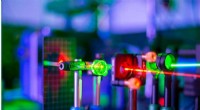
* A laser pointer
* A piece of cardboard or paper
* Two small objects (e.g., coins, pencils)
* A dark room
Procedure:
1. Set up:
* In a dark room, place the two objects some distance apart on the cardboard.
* Position the laser pointer so that the beam passes between the two objects.
2. Observe:
* Turn on the laser pointer and observe the beam of light.
* You should see a straight line of light passing between the two objects.
3. Test:
* Move one of the objects slightly.
* Observe how the beam of light changes direction to pass between the new positions of the objects.
Observations:
* You will observe a straight line of light passing between the two objects.
* When you move one of the objects, the beam of light will bend to follow a new straight line path between the objects.
Conclusion:
* The experiment demonstrates that light travels in a straight line.
* This is because the laser beam is blocked by the objects, forcing it to change direction to continue traveling in a straight line.
Additional Notes:
* The experiment can be made more accurate by using a narrow beam of light.
* You can also use a flashlight instead of a laser pointer, but the beam will be less focused.
Explanation:
Light travels in a straight line unless it is reflected or refracted. This principle is known as the law of rectilinear propagation of light.
In this experiment, the objects act as obstacles that block the path of light. As a result, the light has to change direction to travel around the objects, resulting in a straight line path between them.
This experiment provides a simple and effective way to visually demonstrate that light travels in a straight line.