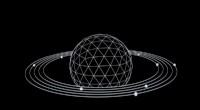
* Attraction Between Masses: Gravity is a fundamental force of nature that attracts any two objects with mass. It doesn't require any physical contact between them to exert its pull.
* Distance and Strength: The strength of the gravitational force depends on the masses of the objects and the distance between them. The farther apart objects are, the weaker the gravitational force between them.
* Universal Nature: Gravity affects everything in the universe, from tiny particles to massive stars and galaxies.
* No Medium Needed: Unlike forces like friction or air resistance, gravity doesn't require a medium (like air or water) to act. It can operate through the vacuum of space.
Examples:
* The Earth's gravity pulls you down to the ground, even though you're not touching the Earth's core.
* The Moon orbits the Earth due to the gravitational attraction between them, despite being separated by a vast distance.
* The Sun's gravity holds all the planets in our solar system in orbit, even though the Sun is millions of miles away.
In contrast, contact forces require direct physical interaction between objects. Examples include:
* Friction: When two surfaces rub against each other.
* Normal force: The force a surface exerts on an object in contact with it.
* Tension: The force transmitted through a rope or cable.
* Applied force: A force exerted directly on an object, like pushing or pulling.