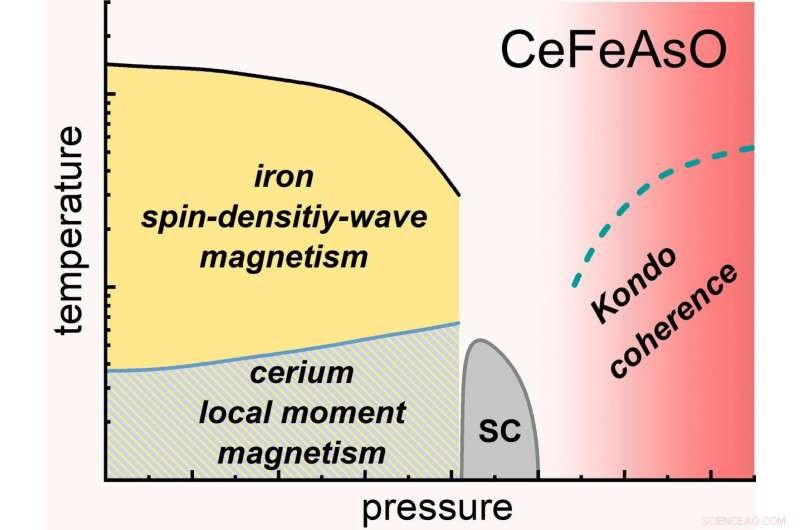
Schematic temperature-pressure phase diagram of CeFeAsO. Credit: MPI CPfS
The understanding of unconventional superconductivity is one of the most challenging and fascinating tasks of solid-state physics. Different classes of unconventional superconductors share that superconductivity emerges near a magnetic phase despite that the underlying physics is different. Two of these unconventional materials are the heavy-fermion and the iron-based superconductors.
Researcher from the Max Planck Institute for Chemical Physics of Solids applied large hydrostatic pressures to tiny single crystals of CeFeAsO, a non-superconducting parent compound to iron-based superconductors, using diamond anvil pressure cells. By electrical, magnetic and structural measurements they showed that upon increasing the applied pressure, the material characteristics change from that of an iron-pnictide material to that of a heavy-fermion metal.
Surprisingly, a narrow superconducting phase emerges in the boundary region between the typical iron-pnictide spin-density-wave magnetism and a Ce-based Kondo-regime. This suggests that the two major phenomena characterizing iron-pnictides and heavy-fermions, spin-density-wave magnetism and the Kondo-effect, work together to produce superconductivity in CeFeAsO.
This work is published in Physical Review Letters and has been selected by the editors to be a PRL Editors' Suggestion.