There are a few different forces that can cause repulsion:
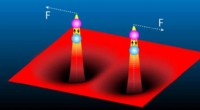
* Electromagnetic Force: This is the force that governs the interaction between electrically charged particles. Like charges repel each other (e.g., two positive charges or two negative charges).
* Strong Nuclear Force: This force is responsible for holding the nucleus of an atom together. While it is primarily attractive, it can also be repulsive under certain circumstances, like in the case of two protons in a nucleus.
* Weak Nuclear Force: This force is responsible for radioactive decay and also plays a role in nuclear reactions.
* Gravity: While gravity is primarily known for its attractive force, there are some theoretical scenarios where it could be repulsive.
Examples of repulsive forces in action:
* Magnets: Two magnets with the same poles facing each other will repel.
* Static electricity: Rubbing a balloon on your hair can create a static charge. When you bring the balloon close to your hair, the static charges repel, causing your hair to stand on end.
It's important to note that while repulsion is the force that pushes objects apart, there's usually another force involved, like magnetism or electromagnetism, that is causing the repulsion.