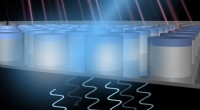
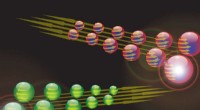
However, I can tell you what happens when a P-wave travels from a solid to a liquid:
* Velocity decreases: P-waves travel faster in solids than in liquids. This is because solids are more rigid and can transmit the compressional force more efficiently. When a P-wave enters a liquid, its velocity slows down.
* Amplitude may increase: The amplitude of the P-wave can increase slightly as it enters the liquid. This is because the wave energy is compressed into a smaller area due to the slower velocity in the liquid.
* Reflection and Refraction: Part of the P-wave energy is reflected back into the solid, while the rest is transmitted into the liquid. This transmission process is called refraction, and the angle at which the wave travels in the liquid is different from the angle in the solid.
In summary: A P-wave slows down and experiences some reflection and refraction as it transitions from a solid to a liquid.