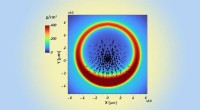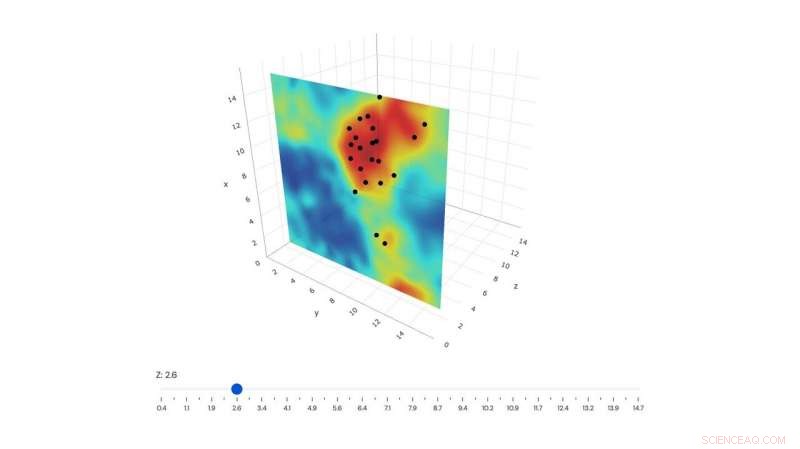
GNN-predicted mobilities (colored from least mobile in blue to most mobile in red) compared to the position of the most mobile particles in the simulation (dots) in a slice of our 3-dimensional box. Better performance corresponds to greater alignment of red areas and dots. The left panel corresponds to a prediction over a short timescale: a regime in which our network attains a very strong performance. In the right panel, corresponding to a timescale 28,000 times longer than the left panel, particles in the glass have started to diffuse. The dynamics are heterogeneous – particle mobilities are correlated locally, but heterogeneous at macroscopic scales – yet our network still makes predictions in agreement with the ground truth simulation. Credit: DeepMind
A team of researchers at Google's DeepMind has developed an AI system that is able to predict the movement of glass molecules as the material transitions between liquid and solid states. They have published a paper outlining their work on the DeepMind website.
Humans have been making glass for approximately 4,000 years. Over those many years, improvements to the process have resulted in the development of many types of glass—but the basic process remains the same. Sand and other silica components are heated to a very high temperature at which they melt, and the resulting material is then rapidly cooled past its crystallization point. The end result of the process is a material that is hard, brittle and allows light to pass through easily. Notably, the molecular structure of glass has no structure at all—under a microscope, the molecules appear to be assembled randomly. Also, when glass is made, something else happens that is of great interest to scientists—its viscosity increases a trillion-fold as it cools to a solid. Intriguingly, despite many years of study, scientists do not really understand the nature of glass or its transition process. Understanding the process would have an impact on more than just the glass industry; it would also explain other similar transition processes, such as colloidal suspensions, granular materials and even cell migration.
To gain some insight into the glass transition process, the researchers used graph neural networking, in which AI is used to develop systems that can work with graphs—nodes and edges—to make predictions about dynamic systems. To use such a system with glass, the team had to convert particles and interactions between them to nodes and edges. In such a system, particles were represented as connecting to nearby particles. The team also had to use an encoder to translate the particles and interactions to mathematical objects that could be recognized by the AI system. Once the AI system received the data, it was processed in a way that produced predictions of particle movement.
The researchers tested their system using multiple datasets and found that it outperformed other AI systems that had tried to do the same—it achieved a 96 percent correlation for short time spans and 64 percent for relaxation demonstrations (which in real-time would be thousands of years).
© 2020 Science X Network