Here's a breakdown:
* Particles: These are the atoms, molecules, or ions that make up the solid.
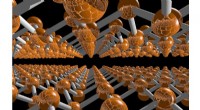
* Repeating Pattern: The particles in a solid are arranged in a highly ordered and repeating pattern. This pattern extends throughout the entire solid.
* Crystal Lattice: The geometric arrangement of the particles in a solid is called a crystal lattice. It's like a framework that holds the particles in place.
Key Features of Crystal Lattices:
* Unit Cell: The smallest repeating unit of the crystal lattice is called the unit cell.
* Lattice Points: Each corner of the unit cell is called a lattice point, which represents the location of a particle.
* Types of Lattices: There are many different types of crystal lattices, each with its own unique geometry. Common examples include:
* Cubic: Simple cubic, face-centered cubic, body-centered cubic
* Tetragonal:
* Orthorhombic:
* Hexagonal:
* Monoclinic:
* Triclinic:
Why is this important?
The arrangement of particles in a crystal lattice greatly affects the physical properties of the solid, such as:
* Hardness: How resistant the solid is to scratching or indentation.
* Melting Point: The temperature at which the solid transitions to a liquid.
* Electrical Conductivity: How well the solid conducts electricity.
* Optical Properties: How the solid interacts with light.
Important Note:
Not all solids are crystalline. Some solids, known as amorphous solids, lack a regular, repeating structure. Examples include glass and rubber.