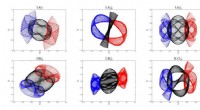
* They are charged: A magnetic field only exerts a force on moving charges. If the particles weren't charged, they wouldn't be affected by the magnetic field.
* The direction of deflection tells you the sign of the charge: The direction of the magnetic force on a moving charge is determined by the right-hand rule. If the particles are deflected in opposite directions, they must have opposite charges.
* The magnitude of the deflection can give you information about the charge and velocity: The strength of the magnetic force is proportional to the charge of the particle, the magnitude of its velocity, and the strength of the magnetic field. By analyzing the deflection, you can get information about these factors.
Here's a breakdown of the key concepts:
* Magnetic force: A moving charge in a magnetic field experiences a force that is perpendicular to both the velocity of the charge and the direction of the magnetic field.
* Right-hand rule: This rule helps determine the direction of the magnetic force. Point your thumb in the direction of the velocity, your fingers in the direction of the magnetic field, and your palm will point in the direction of the force on a positive charge.
* Force on a charged particle in a magnetic field: The magnitude of the force is given by F = qvB sin θ, where q is the charge, v is the velocity, B is the magnetic field strength, and θ is the angle between the velocity and the magnetic field.
In summary, the deflection of charged particles in a magnetic field provides valuable information about their charge, velocity, and the direction of their motion.