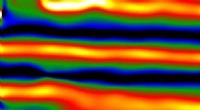
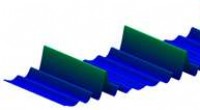
* Type of motion: P waves are compressional waves, meaning they cause particles in the Earth to move back and forth in the same direction as the wave travels. Imagine pushing a spring: the compression moves along the spring.
* Material interaction: This compressional motion is more efficient in solids than in liquids or gases. The particles in a solid are tightly packed, allowing the compression to move quickly from one to the next.
* Speed comparison: P waves are much faster than S waves (secondary waves), which are shear waves causing particles to move perpendicular to the direction of the wave. Shear waves are less efficient in solids, and even slower in liquids.
In simpler terms:
Imagine a line of people holding hands. If you give the first person a quick push, the push (compression) travels down the line quickly because everyone is tightly packed together. That's how P waves work.
Let me know if you want to learn more about P waves, S waves, or other earthquake-related concepts!