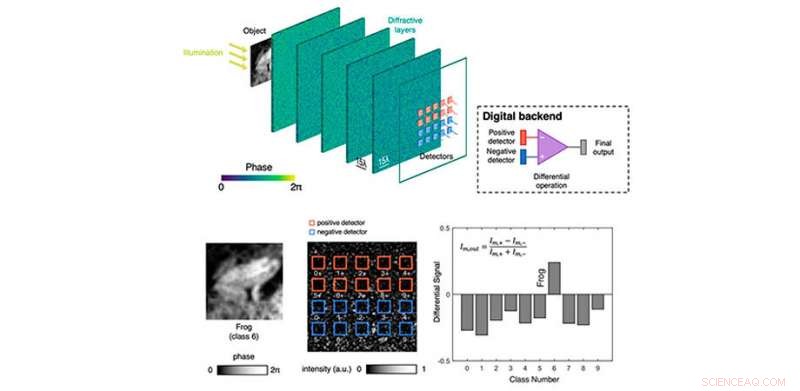
Operation principles of a differential diffractive optical neural network. Since diffractive optical neural networks operate using coherent illumination, phase and/or amplitude channels of the input plane can be used to represent information. Credit: SPIE
A new paper in Advanced Photonics demonstrates distinct improvements to the inference and generalization performance of diffractive optical neural networks.
One of the key improvements discussed in the paper, "Class-specific differential detection in diffractive optical neural networks improves inference accuracy," incorporates a differential detection scheme combined with a set of parallel-operating diffractive optical networks, where each individual network of this set is specialized to specifically recognize a sub-group of object classes.
According to SPIE Fellow Aydogan Ozcan of the University of California, Los Angeles, and one of the paper's authors, these results "provide a major advancement to bring optical neural network-based low-power and low-latency solutions for various machine-learning applications."
This latest research is a significant advance to Ozcan's optical machine-learning framework: The technology is especially significant for recognizing target objects more quickly and with significantly less power than standard computer-based machine learning systems. Ultimately, it may provide major advantages for autonomous vehicles, robotics and various defense-related applications, among others.
These latest systematic advances in diffractive optical network designs have the potential to advance the development of next-generation, task-specific, and intelligent computational camera systems.