Key Principle: Gravity is a force of attraction between any two objects with mass. The more massive the objects, the stronger the gravitational attraction.
How it Works:
* Direct Proportionality: Gravitational force is *directly proportional* to the product of the masses of the two objects. This means:
* If you double the mass of one object, the gravitational force doubles.
* If you double the mass of *both* objects, the gravitational force increases fourfold.
* Inverse Square Law: Gravitational force is also *inversely proportional* to the square of the distance between the centers of the two objects. This means:
* If you double the distance between two objects, the gravitational force decreases to one-fourth of its original strength.
Comparing Small and Large Masses:
* Small Masses: Objects with small masses have a very weak gravitational pull on each other. This is why we don't feel the gravitational force between ourselves and everyday objects.
* Large Masses: Objects with large masses, like planets and stars, have a much stronger gravitational pull. This is why we are held to the Earth's surface and why the Moon orbits the Earth.
Example:
Imagine you have two objects: a bowling ball (small mass) and the Earth (large mass).
* The gravitational force between the bowling ball and the Earth is much stronger than the gravitational force between the bowling ball and a nearby pencil.
* This is because the Earth's mass is significantly larger than the pencil's mass.
In Summary:
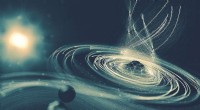
The more massive an object, the stronger its gravitational pull on other objects. This is why planets have strong gravitational fields that hold their moons in orbit, and why stars exert gravitational forces on entire solar systems.