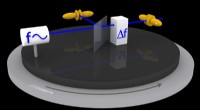
The Setup:
* Alpha Source: A radioactive source, like radium, emitted alpha particles (positively charged helium nuclei).
* Gold Foil: A very thin sheet of gold foil was used as the target.
* Detector: A fluorescent screen was positioned around the gold foil to detect the alpha particles after their interaction with the foil.
The Observations:
* Most Alpha Particles Passed Straight Through: The majority of the alpha particles went straight through the gold foil, with no significant change in direction. This observation was unexpected, as scientists at the time thought the atom was a uniform, positive sphere of matter with electrons scattered throughout.
* Some Alpha Particles Deflected: A small number of alpha particles were deflected at various angles.
* A Few Alpha Particles Deflected Backwards: Most remarkably, a tiny fraction of alpha particles were deflected backwards, almost as if they had hit a solid object.
The Explanation:
Rutherford interpreted these results and proposed the following model of the atom:
* Nucleus: The atom has a tiny, dense, positively charged nucleus at its center. This is where most of the atom's mass resides.
* Electron Cloud: Electrons are negatively charged and orbit the nucleus in a cloud-like manner.
Why the Deflection:
* Straight Through: Most alpha particles passed straight through because the atom is mostly empty space.
* Deflection: When an alpha particle came close to the nucleus, it experienced a strong electrostatic repulsion due to the positive charges of both the nucleus and the alpha particle. This repulsion caused the alpha particle to deflect from its original path.
* Backscattering: The few alpha particles that were deflected backwards had a direct collision with the nucleus. The strong repulsion from the nucleus caused them to bounce back.
Key Points:
* Nuclear Model: The Geiger-Marsden experiment led to the development of the nuclear model of the atom, which replaced the earlier plum pudding model.
* Discovery of the Nucleus: The experiment proved the existence of a small, dense, positively charged nucleus at the center of the atom.
* Importance: This experiment revolutionized our understanding of atomic structure and paved the way for further discoveries in nuclear physics.