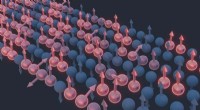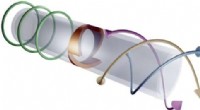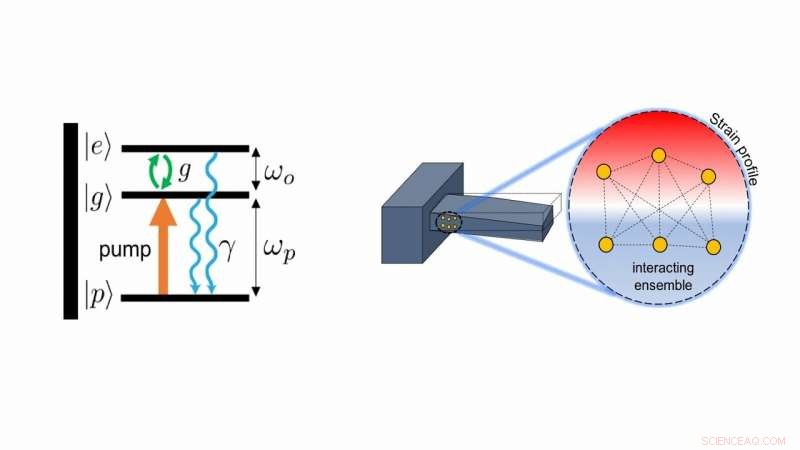
(left) Model of cooling cycle: an external laser pumps atoms into a two-level subspace coupled directly to a mechanical resonator; phonon absorption results in cooling of the mechanical system. (right) Schematic of a mechanical resonator interacting with an atomic ensemble. The engineered strain profile couples to dark entangled states of the ensemble resulting in optimal cooling. Credit: Argonne National Laboratory
Center for Nanoscale Materials researchers present a quantum model for achieving ground-state cooling in low frequency mechanical resonators and show how cooperativity and entanglement are key factors to enhance the cooling figure of merit.
A resonator with near-zero thermal noise has better performance characteristics in nanoscale sensing, quantum memories, and quantum information processing applications. Passive cryogenic cooling techniques, such as dilution refrigerators, have successfully cooled high-frequency resonators but are not sufficient for lower frequency systems. The optomechanical effect has been applied successfully to cool low-frequency systems after an initial cooling stage. This method parametrically couples a mechanical resonator to a driven optical cavity, and, through careful tuning of the drive frequency, achieves the desired cooling effect. The optomechanical effect is expanded to an alternative approach for ground-state cooling based on embedded solid-state defects. Engineering the atom-resonator coupling parameters is proposed, using the strain profile of the mechanical resonator allowing cooling to proceed through the dark entangled states of the two-level system ensemble. This approach enables ground-state cooling despite weak interaction strengths commonly seen in experimental settings. Entanglement and cooperative effects are key factors to enhance the cooling figure of merit.
The results apply to a variety of systems such as silicon and nitrogen vacancy centers in diamond and quantum dots, and advance the potential for miniaturization and room-temperature operation required for long-term technological applications. This work paves the way for ground-state cooling experiments using solid-state defects. The approach, accessible for experimental demonstrations and universal to a variety of systems, overcomes the main obstacles that have blocked realization of ground-state cooling using embedded solid-state defects.
Rigorous quantum simulations of interacting 2-level systems (atoms, NV centers, etc.) embedded within a mechanical resonator (e.g., microscale cantilever) were performed. Engineering the local phase of the coupling strengths using the strain profile in mechanical resonators enables efficient cooling mediated by cooperativity and entanglement.