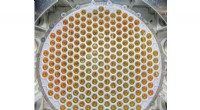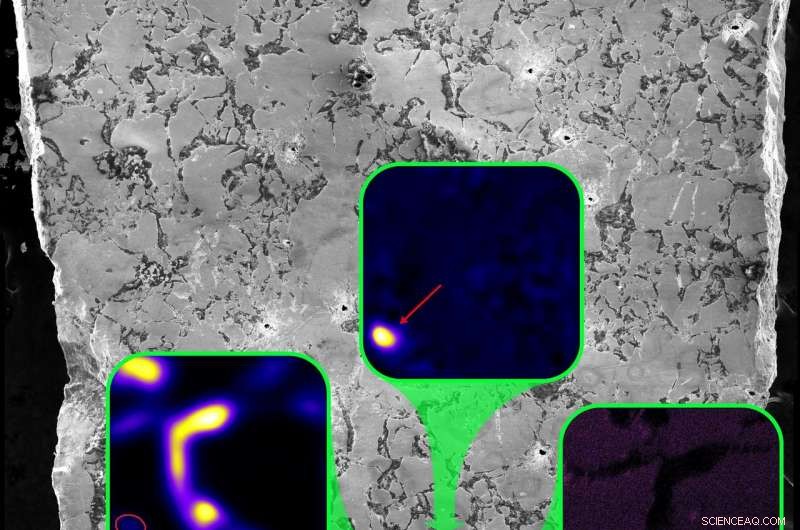
A scanning electron microscope image of uranium ore from the Oklo natural nuclear reactor. Insets show fissionogenic Cs and Ba hotspots. Credit: PNAS
A team of researchers from the U.S. Naval Research Laboratory and Washington University has learned more about possible ways to store modern nuclear waste by studying an ancient natural fission reactor. In their paper published in Proceedings of the National Academy of Sciences, the group describes their study of cores taken from the natural Oklo nuclear reactor and what they found.
As scientists continue to search for new more environmentally friendly ways to produce power, the old ways continue to generate waste. One such source is waste from nuclear power plants. Various options regarding how to store it long term have been discussed, but few have panned out, leaving waste to be temporarily stored onsite. In this new effort, the researchers sought to learn more about what actually happens as nuclear waste decays over its active lifetime. To learn more, they traveled to Gabon, located in West Africa. At a location known as Oklo, there exists the remains of a natural nuclear reactor. Due to a variety of events, the site was the scene of naturally occurring fission approximately 2 billion years ago. The uranium-235 that drove the reactions has long since decayed, but the history of how that occurred remains.
To learn more about what happened as the fissionable material decayed, the researchers took core samples and brought them back to their lab, which houses the Naval Ultra Trace Isotope Laboratory's Universal Spectrometer. There, they were able to piece together the history of the radioactive material as it moved through its elemental states, some of which included isotopes. Of utmost concern was what became of the cesium that was produced as a byproduct of uranium fission. Cesium has been found to be particularly hazardous due to its high degree of radioactivity—it was released into the environment after both the Fukushima and Chernobyl accidents. The researchers found that it was absorbed by an element called ruthenium, approximately five years after the reactor ceased. It was held there in place for almost 2 billion years.
The researchers suggest that discovering that cesium had been contained by ruthenium offers some ideas on possible ways to deal with waste produced in modern reactors. They further note that ruthenium is too rare to use, but something like it might do the trick. They plan to investigate further.
© 2018 Phys.org