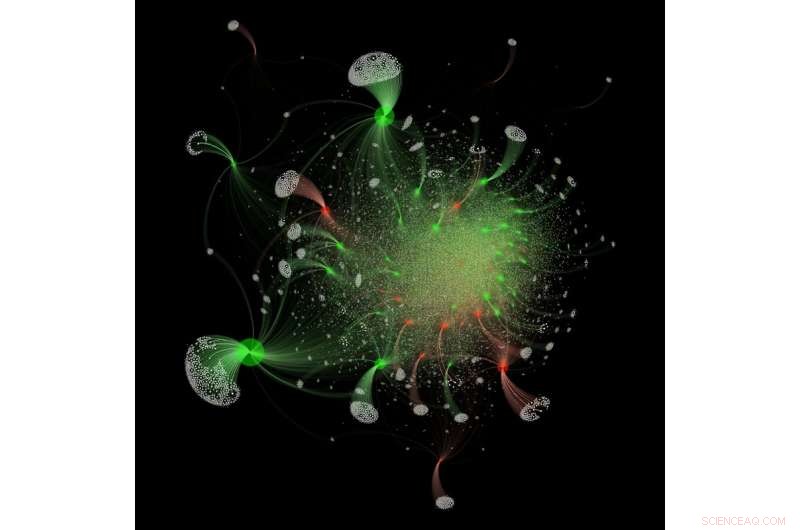
Extremism in the offing. Depiction of connected groups among pro-ISIS users of the Russian VKontakte social network, captured in January 2015. The snapshot depicts the network a few days after the emergence of a pattern that indicated imminent, large-scale group formation, as identified by a new theoretical analysis. Clusters shown in red were later flagged by system moderators as potentially dangerous and shut down. Credit: P. Manrique & M. Zheng/Univ. of Miami, via Physics
A team of researchers from the University of Miami and George Washington University has developed a model to simulate terrorist group development using the physics surrounding the behavior of gels. In their paper published in the journal Physical Review Letters, the group describes manipulating physics theories to make them work in a simulation they created. They also report on how well the simulation performed when they compared it to the growth of a real-life terrorist group.
Modern technology has allowed smaller groups to exert a bigger influence on the world around them using aggressive tactics. The internet, for example, allows individuals from around the world to converge, interact and if they so desire, form groups capable of carrying out terrorist activities. Sadly, modern law enforcement groups have found it difficult to identify and stop such groups before they carry out these attacks. The researchers with this new effort insist part of the problem is in the "lone wolf" approach that is so often used in such efforts. They suggest a better way might be to note how milk curdles and to use models based on it.
The researchers note that internet group formation quite often resembles gel formation in some ways—the way milk curdles, for example. Individuals meet and form a pair. Pairs meet others and form clusters. Clusters grow in size until at some point, a group emerges. They further note that gel formation has been studied and math has been developed to describe and predict such behaviors. This inspired them to apply such models to predict the growth of terrorist groups.
The researchers noted that one difference between human group formation and gel formation is that gel formation involves interactions between identical elements. They got around that problem by creating elements with a characteristic that could be represented by a number between 0 and 1. Interactions between elements that randomly came into contact with one another were then based on matching characteristics.
The researchers report that the simulation showed terrorist cell groups forming, and more importantly, the point at which they jelled, allowing them to act. This jelling point, they discovered, followed a 5/2 power law distribution. They further report that when they ran their simulation using data from a Russian internet site regarding formation of an ISIS group, they found that it reliably predicted the jelling point. They suggest that such tools might be useful to law enforcement in the coming years.
© 2018 Phys.org