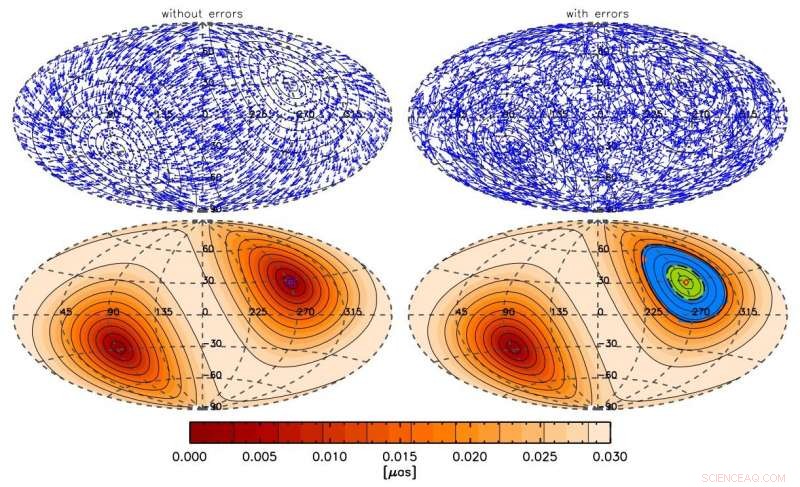
Top: all-sky isotropic distribution of a Monte Carlo simulated sample of distant extragalactic objects. On the left panel, 2-dimensional blue vectors show the (out of scale) CAD signal expected for the LG moving towards the apex of the CMB temperature dipole, while on the right panel a random, and dominant, error component, illustrating astrometric imprecisions is added. Bottom: we simulate the CAD signal reconstructed from a sample of 2·106 sources with an EoM astrometric accuracy on proper motions of σ = 0.6 and 1.4 µas yr−1 respectively. The red color scale shows the amplitude of the signal (the red diamond represents the simulated direction of the observer’s motion), while the green/blue regions display the solid angle within which 68% of the reconstructed apex directions lie. The imprecision in the dipole position is estimated using 10000 Monte Carlo realisations and compared to the analytical predictions given in the text (thick black lines). Credit: arXiv:1802.04495 [astro-ph.CO]
A pair of physicists at Aix-Marseille University has offered a possible way to measure the speed of our own galaxy more accurately as it moves through space. In their paper published in the journal Physical Review Letters, Julien Bel and Christian Marinoni describe their theory and how it might be tested.
Most people know that our planet is moving not just around the sun, but through space as part of the Milky Way galaxy. Prior research has suggested that our galaxy is moving through space at over 1 million miles per hour. Such estimates are based on measuring changes in the position of the Earth relative to very distant objects in the night sky by measuring the amount of redshift and then comparing them against each other. Bel and Marinoni argue that it should be possible to get betters estimates of our galaxy speed by studying objects that are much closer to us.
The researchers suggest that the key to measuring our own speed is to measure our own acceleration relative to the acceleration of other objects in the universe (they note both instances of acceleration are due to dark energy-driven universal expansion and gravitational pull between objects). They suggest it could be done by watching and measuring other galaxies very closely and tracking just how much their positions relative to Earth change over time. They note that doing so would not be easy—some might even claim it is impossible with today's technology. But Bel and Marinoni argue that new technology like that used on the Large Synoptic Survey Telescope or even the Square Kilometer Array would likely be all that is needed. It would just take a concerted effort to use them for such a purpose.
The researchers note that their idea is still just a proposal at this time. They are still working on more concrete details, a hint that it is unlikely efforts to test their ideas with new telescopes will be undertaken any time soon. They note that if their ideas do pan out some day, information learned in such an effort could help prove some theories and perhaps constrain others.
© 2018 Phys.org