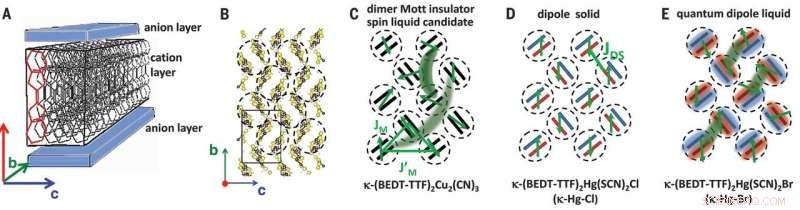
Crystal structure and phases of BEDT-TTF–based crystals. Credit: Science (2018). DOI: 10.1126/science.aan6286
A team of researchers with members from several institutions in the U.S. and Russia has found evidence that suggests spin liquids in ferromagnets may be similar to dipole liquids in ferroelectrics. In their paper published in the journal Science, the group describes their study of molecular crystals and what they found. Ben Powell with the University of Queensland offers a Perspective piece on the work done by the team in the same journal issue.
As Powell explains, the researchers were looking at the behavior of dipole liquids, which are theorized particles that are still not very well understood. Some phases of matter are relatively easy to observe—the spins of ferromagnets, for example. Other are not, such as the spin liquids. In this new effort, the researchers took advantage of features unique to molecular crystals—the structure and dipole inherent in dimer Mott insulators. To that end, they studied specific types of salts, noting that in the dimer Mott phase, most such dimers have a +1 charge. To conduct their study, they used Ramen scattering, comparing what they observed against vibrational models. Doing so allowed them to analyze dipolar fluctuations.
The researchers report that they believe their experiments revealed evidence of excitations of dipoles or perhaps hybrid spin-dipole excitations that were provoked by interactions between the unpaired spins and dipoles. This, Powell explains, leads to the question of whether spin-dipole interactions might be involved in the particles observed in the salts—that is, if the excitations actually have hybrid spin dipole characteristics. If so, there lies the possibility that dipole liquids are similar in nature to spin liquids. If that is the case, Powell says, then the work by the team might have led to more questions than answers. But in either case, it offers other physicists new avenues of research efforts. Powell concludes by suggesting further work might involve the development of new tools that can be used to probe particle-like excitations directly—a means of proving one way or another if the two liquid states are truly alike, and if so, how closely.
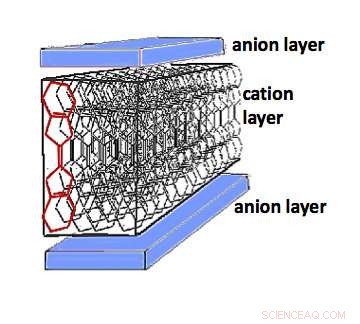
The structure of the crystal that was studied in the research; an individual molecule is highlighted in red. Credit: Institute for Quantum Matter/JHU
© 2018 Phys.org