Here's why:
* Speed of Light: The speed of light in a vacuum is a fundamental constant, denoted by 'c', which is approximately 299,792,458 meters per second.
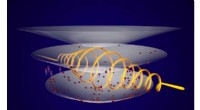
* Medium Effects: When light travels through a medium (like air, water, or glass), it interacts with the atoms and molecules of that medium. This interaction causes the light to slow down.
* Refractive Index: The extent to which light slows down in a medium is measured by the refractive index of that medium. A higher refractive index means the light travels slower.
Therefore, the speed of light is at its maximum in a vacuum, where there are no particles to interact with.