A team of researchers at the California Institute of Technology has taken a hard look at the challenges facing efforts to carry out the Breakthrough Starshot project. In their Perspective piece published in the journal Nature Materials, the researchers outline the obstacles still facing project engineers and possible solutions.
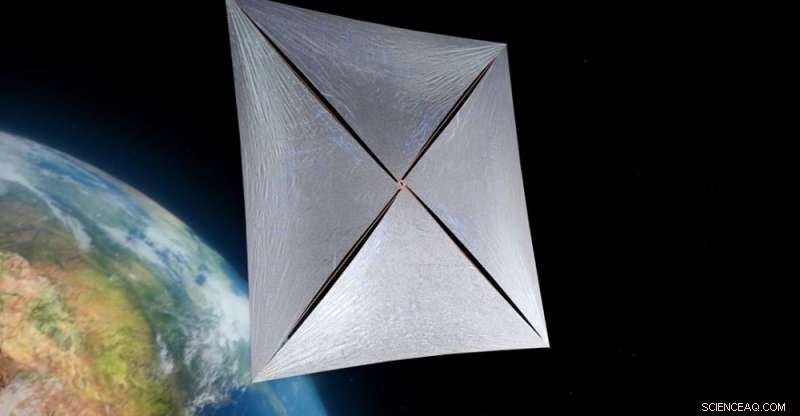
Breakthrough Starshot is a project launched by backer Yuri Milner two years ago—its aim is to send a spacecraft out of the solar system toward Alpha Centauri by the middle of this century. Most designs for such a spacecraft surround the idea of a light sail and a tiny device to allow for communications. The craft would be powered by a laser array situated on Earth. To reach Alpha Centauri in a reasonable amount of time, the craft will need to travel very fast, close to 20 percent of the speed of light. Alpha Centauri is, after all, 4.37 light years away. And while the concept is relatively simple, the design presents serious challenges, as the team highlights.
A light sail can be pushed by beams from a laser due to momentum carried by photons, the researchers note. But for it to work, the sail must be reflective. It will also have to be very thin (perhaps just a few atoms across) and lightweight, less than a gram. Thus far, engineers have looked at graphene, but it is not reflective, which means it would need a coating of some sort. On the other hand, reflective materials such as metals are too heavy. A suitable material has not yet been found, the team reports.
Another challenge the team will face is how to keep multiple laser beams steady and focused as they pass through the Earth's atmosphere. That will likely mean use of low near-infrared beams, which means the sail would have to be able to reflect such wavelengths of light. But then issues of weight and heat generation come into play. Such issues, the team notes, mean that engineers will have to balance many factors to find just the right combination of materials.
Something else the team will have to consider is the shape of the sail—it will not likely be a simple flat sheet, because imperfections on its surface would send the craft careening off into space. Instead, engineers will have to develop a design that allows for self-correction.
© 2018 Phys.org