Solid:
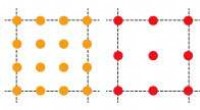
* Particle arrangement: Particles in a solid are tightly packed together in a regular, repeating pattern (a crystal lattice).
* Motion: Particles vibrate in fixed positions, with only limited movement. They have low kinetic energy.
* Shape and volume: Solids have a definite shape and volume because the particles are fixed in their positions.
Liquid:
* Particle arrangement: Particles in a liquid are closer together than in a gas, but not as tightly packed or ordered as in a solid. They can move around each other.
* Motion: Particles in a liquid move around more freely than in a solid, but they are still relatively close together. They have higher kinetic energy than solids.
* Shape and volume: Liquids have a definite volume but take the shape of their container because the particles can move around and flow.
Gas:
* Particle arrangement: Particles in a gas are far apart and move randomly in all directions. There is no fixed arrangement.
* Motion: Particles in a gas have the highest kinetic energy. They move very rapidly and collide frequently with each other and the walls of their container.
* Shape and volume: Gases have no definite shape or volume, taking the shape and volume of their container because the particles move freely.
Plasma:
* Particle arrangement: Similar to a gas, but with a large number of ions and free electrons.
* Motion: Particles in a plasma move very rapidly and collide frequently. They have even higher kinetic energy than gases, with some particles even ionizing other particles.
* Shape and volume: Like a gas, plasma has no definite shape or volume.
In summary:
* Solids: Particles vibrate in fixed positions with low kinetic energy.
* Liquids: Particles move around each other with higher kinetic energy than solids.
* Gases: Particles move randomly and freely with very high kinetic energy.
* Plasma: Similar to a gas, but with ionized particles and even higher kinetic energy.
The differences in particle motion are why the states of matter have different properties.