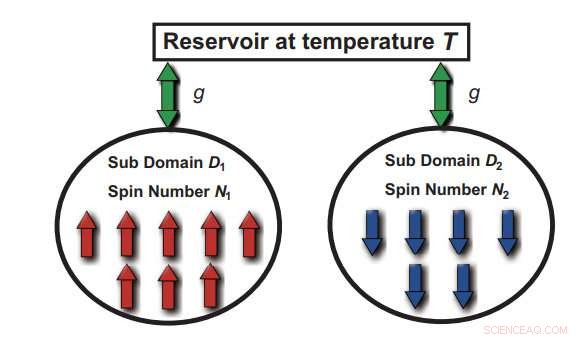
Schematic representation of a double spin domain system coupled to a single reservoir. Here we denote the first spin domain containing N1 spins as D1 where the spins are shown as red arrows, the second spin domain 2 with N2 spins is labelled as D2 with the spins represented by the blue arrows. In both domains, each spin couples with the bosonic reservoir (at temperature T ) with the coupling constant g. Credit: arXiv:1612.08963 [quant-ph]
A team of researchers from several institutions in Japan has described a physical system that can be described as existing above "absolute hot" and also below absolute zero. In their paper published in the journal Physical Review Letters, the group outlines their ideas on collective spins in double domain systems and the interesting situations that can occur within them.
The concept of temperature has evolved over a very long period of time, from descriptions of simple sensations to theoretical states of physical systems. In their paper, the researchers with this new effort describe their investigation of relaxation in dual collective spins in a double domain system and some configurations that can result under certain extreme circumstances. Of particular interest are situations involving spin domains in antiparallel configurations, which, when unbalanced, can wind up relaxing toward a negative temperature state. At first glance, such an occurrence would seem impossible, because it suggests there is a circumstance in which some bit of material could be cooled below absolute zero, which, of course, goes against current understanding—but theory suggests it is possible.
The idea of a negative temperature state is used by the researchers as an explanation of an occurrence in the real world—population inversion, in which atoms are pushed from a lower energy level to a higher energy level and are then allowed to fall back, resulting in light emission. This is how laser pointers work. When physicists discovered such a property was possible, they took another look at spin, which gives atoms their magnetic properties, and found that spin systems could be coaxed into behaving in more ways than was thought possible—some have even been found to become inverted, which could lead to a system that flows naturally upward in energy levels.
In this new effort, the researchers report the possibility of pockets of atoms, two in this case, to have spins that share a reservoir, and which have a fixed temperature. When the two pockets are the same size, the math showed, half of the spins wind up in a higher state, and the other half in the lower state. But when the pockets are different sizes, the spins wind up flowing toward the higher state, making one pocket more inverted than the other, leading to the idea of negative temperatures.
© 2018 Phys.org