Credit: P. Jerabek et al. [4] and APS/Alan Stonebraker
A team of researchers from the U.S., New Zealand and Norway has used computer simulations to predict several characteristics of the heaviest element, oganesson. In their paper published in the journal Physical Review Letters, the group explains the factors that went into the simulation and discuss what it showed.
Back in 2002, a group of researchers from the U.S. and Russia succeeded in creating an atom of oganesson, the heaviest element on the periodic table. Named after Russian physicist Yuri Oganessian, the element has been notoriously difficult to study due to its short half-life (less than a millisecond). For that reason, most of its fundamental characteristics were determined using atomic calculations. In this new effort, the researchers have applied several physics techniques to derive predictions regarding other characteristics of the superheavy noble gas.
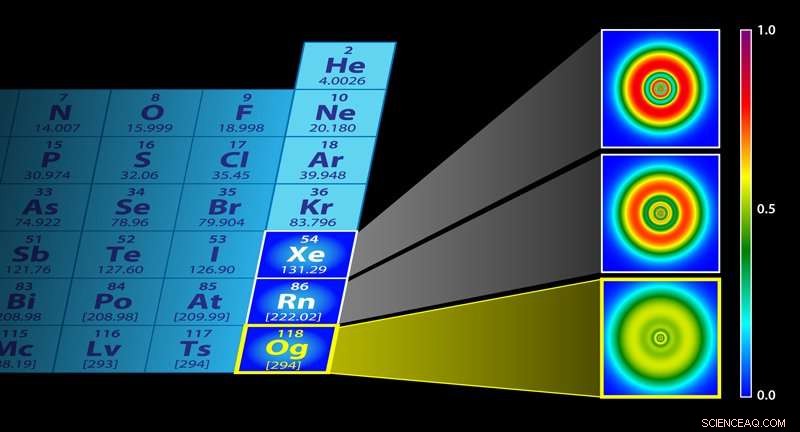
To give the simulation a means for calculating characteristics of the element, the group used fermion localization. That allowed them to create maps showing localizations for both electronic systems and nuclear systems. The researchers say it is likely that the element has uniform distribution of both electrons and nucleons, which was a surprise, because it contrasts sharply with nonuniform shells seen in lighter elements. These findings suggest that oganesson likely has characteristics or properties that differ from the other noble gases. The researchers also noted a surprisingly high value for spin-orbit coupling.
To learn more about the electronic structure of the element, the group made some assumptions regarding electrostatic forces causing electron energy levels to overlap, resulting in smooth electron shells. To back up their assumptions, the team added an electron localization function to the simulation, which allowed them to compare the electronic structure of oganesson with other noble gases. This revealed that the shell features were nearly the same, a finding that suggests the element would have strong Van der Waals forces between same-type atoms. The simulation also revealed more about properties inside the nucleus that would also contribute to a smooth shell structure.
The work is likely to inspire other new efforts geared toward measuring or observing the characteristics suggested by the simulation. It could also spur efforts to learn more about the element's strange properties.
© 2018 Phys.org