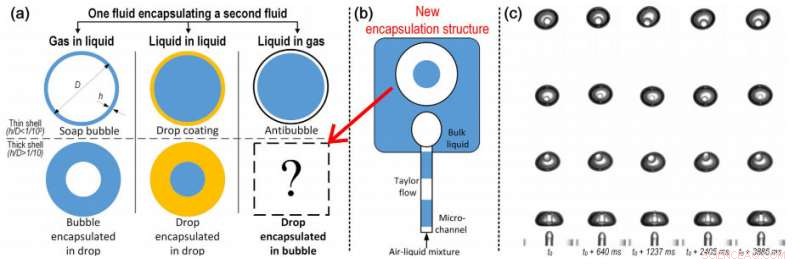
(a) Drop encapsulated in bubble, which is the last unknown area in the fluid encapsulation map. (b) Diagram of the experiment setup. (c) Stable production of uniform capsules (see Supplemental Material for the multimedia view). Credit: Physical Review Letters (2018). DOI: 10.1103/PhysRevLett.120.054503
A team of researchers at Zhejiang University in China has developed a technique to create liquid droplets inside of air bubbles. In their paper published in the journal Physical Review Letters, the group describes the technique and some possible commercial applications.
Physicists study bubbles and droplets because of the unique processes involved, and because doing so has led to the development of many useful applications such as inkjet printers. In this new effort, the researchers applied known properties of glycerol-water solutions in a unique way to generate liquid-suspended air bubbles containing a liquid drop inside of them.
To create such bubbles, the researchers forced small amounts of alternating liquid and air through a tube into a tank filled with a liquid solution, causing the generation of a so-called "Taylor flow," alternating "slugs" of liquid and air bubbles. When an air bubble entered the tank, it was forced off the nozzle by the slug behind it—and when the conditions were just right, the team reports, that push by the slug forced a droplet into the air bubble, which then persisted in the solution for a length of time—the drop was released when the bubble encountered a solid surface, i.e., ran into the side of the tank. The team refers to their creation as a "drop encapsulated in a bubble."
The group further reports that for encapsulation to occur, the ratio of surface tension on the bubble to the degree of viscosity must be at a certain point as must the height to width ratio of the slug as it begins to make its way into the bubble. They note also that the drop inside the bubble showed an ability to withstand sheer flow. They suggest the technique could lead to the development of new ways to deliver medications or a means for processing materials in a manufacturing environment. One example, they point out, would be a novel way to create capsules of different sizes. They also note that it could be used as a means of fluid transport.
© 2018 Phys.org