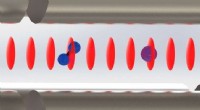
1. Orbital motion: Electrons orbiting the nucleus of an atom create a tiny magnetic dipole moment. This is similar to a current loop generating a magnetic field. The overall magnetic property of the material arises from the alignment (or lack thereof) of these individual atomic dipoles.
2. Spin motion: Electrons themselves have an intrinsic angular momentum called spin. This spin also generates a magnetic dipole moment, contributing to the overall magnetic properties of the material.
The relative strength and alignment of these two types of motion determine the magnetic property of the material. For example, in diamagnetic materials, the orbital motion of electrons is the primary contributor to the magnetic property, while in ferromagnetic materials, the alignment of electron spins plays a crucial role.