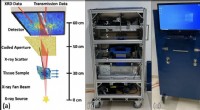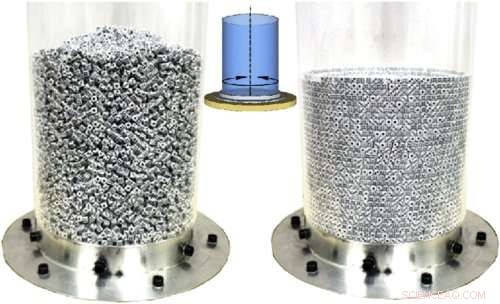
Experimental cell and sketch of the twist excitation. The pictures show the initial (left) and final (right) states for a ensemble of 25 000 cubes submitted to N = 3×10⁵ twists of intensity Γ=1.01. Credit: Physical Review Letters (2017). DOI: 10.1103/PhysRevLett.119.228002
(Phys.org)—A small team of researchers from Universidad de Navarrahas in Spain and Cinvestav Unidad Monterrey in Mexico has found that applying alternating twists to a cylinder full of square dice causes the dice to line up. In their paper published in the journal Physical Review Letters, the group describes their experiments with agitating dice and what they found.
Most people have witnessed what happens when randomly agitating a jar full of rocks, nuts or other hard objects—over a short time, they line up in a way that causes them to become more compacted. Manufacturers have learned to take advantage of this by designing machines that agitate or tap containers to compress the materials. In this new effort, the researchers report that alternating agitation does an even better job, at least with small, square objects.
In their experiments, the researchers loaded 25,000 plastic dice, each approximately a half-centimeter on a side, into a clear cylinder. They then applied different agitation effects to the cylinder to see which might cause the most effective compaction. They found that an alternating twisting, similar to that used by a common clothes washing machines worked best—but only when enough acceleration was applied. They found that the applied rotation exerted an outward force against the walls of the cylinder while the jolt that occurred when a spin motion was suddenly halted and then reversed caused the dice to shuffle slightly. Applying the alternating twisting technique caused the dice to line up top to bottom and also to form concentric circles when looked at from above.
The researchers also found that for the technique to work, enough rotational acceleration had to be applied to sufficiently cause a useful amount of movement by the dice when it was suddenly halted. More specifically, they found that acceleration of approximately half that of gravity caused the dice to reach a maximum density after 10,000 alternating twists. Lower accelerations were not sufficient to cause the dice to line up in a reasonable amount of time.
The researchers suggest their findings offer a possible new means of compacting materials as part of a manufacturing processes.
© 2017 Phys.org