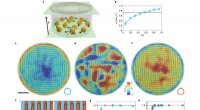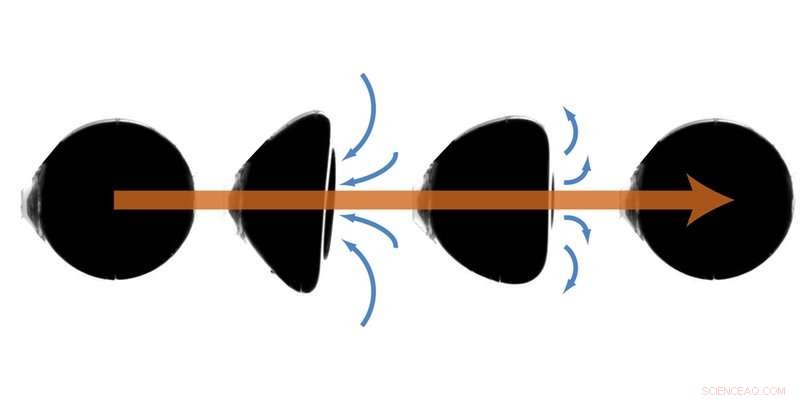
Going with the flow. A new swimmer design is a sphere that collapses and re-inflates with changes in the applied pressure. The swimmer takes on slightly different shapes during the two phases of the deflation–re-inflation cycle, which generates asymmetric flow in the surrounding fluid (arrows) that allows it to make forward progress. Credit: A. Djellouli/CNRS/Grenoble Alps Univ.
(Phys.org)—A team of researchers at Université Grenoble Alpes has developed a new way to propel an object through highly viscous fluids. In their paper published in the journal Physical Review Letters, the group describes their idea and how well prototypes worked when tested.
Medical researchers have been searching for a way to send tiny robots through the body to deliver drugs or to perform microsurgery, but have faced many hurdles in achieving that goal. One obstacle involves operating a tiny robot in an environment dominated by viscous forces. Because of this, researchers have limited options for robot propulsion. Natural microorganisms get around the problem by changing their shape in different directions depending on whether they are involved in a propulsive stroke, or returning to an original form. Mimicking this activity has proven to be difficult in the lab. In this new effort, the researchers have found an entirely new way to propel a tiny robot moving in a high-viscosity environment.
The new approach entails creating a balloon of sorts with a top half that has thinner walls than the bottom half. When the balloon is filled with air, it appears the same as other balloons, as a mostly spherical shape. But when air is removed from the new balloon, the top half deflates while the bottom half retains its shape, creating first a flattened configuration and then a dimple. When the balloon is deflated while immersed in a high-viscosity fluid, it moves in the direction of the dimple due to friction between the liquid and the surface of the dimple. But because the balloon regains its shape in a different way during inflation, the balloon is not pulled back to its original position.
The researchers built a balloon prototype with a diameter of just 5cm and a small air hose. The balloon was then placed into a liquid that was 10,000 times more viscous than water. They report that they were able to maneuver the balloon forward by repeatedly filling it with air and then releasing the pressure. They suggest future models could use ultrasound to inflate and deflate the balloon to propel them inside of the body.
© 2017 Tech Xplore