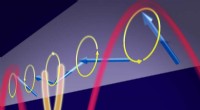
* Refraction: When light passes from one medium (like air) to another (like plastic), it changes speed. This change in speed causes the light to bend, a phenomenon called refraction.
* Curvature: The curved surface of the plastic container creates a varying angle of incidence for the light rays. The angle of incidence is the angle between the incoming light ray and the normal (a line perpendicular to the surface) at the point of entry.
Here's how it works:
1. Different Angles: As the light ray enters the curved surface, it encounters different angles of incidence at different points.
2. Bending: Because of the different angles, the light ray will bend differently at different points along the curve.
3. Focal Point: In some cases, if the curvature is strong enough, the bent light rays could converge at a single point called the focal point. This is how lenses work.
Example: Imagine a magnifying glass, which is essentially a curved piece of plastic. When light passes through it, the rays converge at a point, magnifying the object.
In summary: The curved surface of the plastic container will cause the incident light rays to bend due to the phenomenon of refraction, resulting in different paths of the light rays.