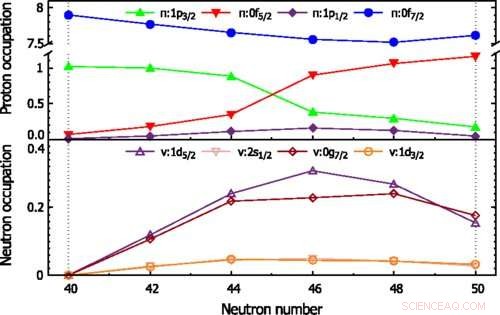
Occupation levels from the PFSDG-U calculation given in total numbers of protons and neutrons along the copper chain (for even N). Credit: (c) Physical Review Letters (2017). DOI: 10.1103/PhysRevLett.119.192502
(Phys.org)—Two teams of researchers working independently of one another and using wildly different approaches have confirmed nickel-78 to be doubly magic. In the first effort, an international team led by Louis Olivier with the National Institute of Nuclear and Particle Physics produced a copper-79 nucleus and used it as a framework for describing nickel-78. In the second effort, a team with members from across Europe approached the problem by using an advanced weighing technique. Both teams have published their results in the journal Physical Review Letters.
In the world of physics, magic numbers describe protons or neutrons in orbital shells separated by the greatest energy gaps. When both protons and neutrons are magic, the nucleus is deemed doubly magic. In their never-ending search to understand matter, scientists have studied magic and doubly magic nuclei and found some to be particularly difficult to pin down. Nickel-78 is a prime example. Study has been hampered by its tendency to be short lived and the difficulty in producing it at all. In this new effort, both teams have resorted to tricks to show that it is, indeed, doubly magic.
In the first approach, the team led by Olivier used a knockout reaction to eject a proton from a zinc-80 projectile, resulting in a copper-79 nucleus. They then used shell model calculations to show that copper-79 could be characterized as a doubly magic nickel-78 nucleus with an added proton. In the second approach, the team measured the mass of the copper isotopes in a chain from copper-75 to 79 using technology at CERN. They used what they found to show that copper-79 can be characterized as an individual proton sitting atop a doubly magic nickel-78 core.
While the methods used by the second team were quite different, the results were in agreement—nickel-78 is, indeed, doubly magic. This is not the end of the story, however, because both studies involved indirect approaches. Thus, nickel-78 will not be considered proven as doubly magic until it can be shown directly. To do that, some future research team will need to produce it in a lab in a way that allows for direct testing.
© 2017 Phys.org