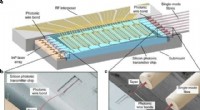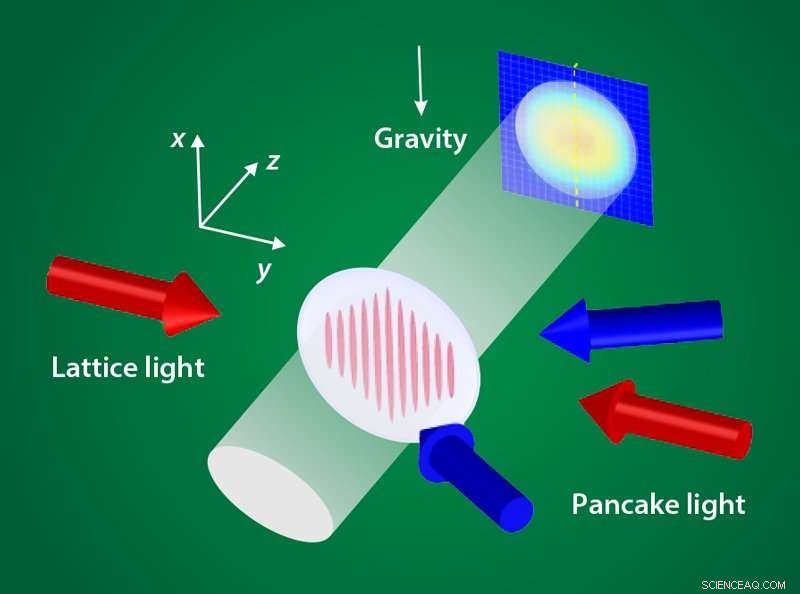
Sketch of the experimental setup used by Yang et al. Arrays of rubidium-87 atoms, cooled and trapped by laser beams, exhibit Tomonaga-Luttinger liquid (TLL) behavior. Credit: Philip Krantz, Krantz NanoArt, adapted by APS/Alan Stonebraker, via Physics
(Phys.org)—Two teams of researchers working independently of one another have found ways to test aspects of the Tomonaga–Luttinger theory that describes interacting quantum particles in 1-D ensembles in a Tomonaga–Luttinger liquid (TLL). The first team, with members from China, Germany and Australia demonstrated TLL behavior with cold atoms in a 1-D array. The second team, with members from Australia, Germany and Russia, tested TLL predictions using a 1-D array of Josephson junctions to look at the impact of disorder in TLL physics. Both teams have published details of their work in Physical Review Letters.
Understanding how quantum particles behave in 1-D environments is critical for creating the best possible nanowires or carbon nanotubes. TLL theory offers a way to look at the many-body interactions that occur in such systems. Unfortunately, very few aspects of the theory have been tested experimentally due to the difficulty of creating and manipulating a 1-D system. But despite the hurdles, physicists continue to look for ways to prove various parts of the theory. In these two new efforts, the research groups have devised two new ways to test aspects of the theory.
In both efforts, the teams sought to create simulations that could demonstrate principles of TLL theory. The first sought to do so by setting up rubidium-87 atoms in a 1-D array, trapping them with a laser and then causing them to be ejected with pulses from another laser. Doing so created a density wave that propagated outward from the center of the trap. The homogenous nature of the atomic density of the wave offered an analog of a TLL. Measuring the density and the speed that sound traveled in the trap allowed the researchers to work out TLL parameters used to represent quantum fluctuations that could then be compared against TLL theory.
In the second effort, the group used superconducting material to build a line with Josephson junctions every 1 μm—the Cooper pairs were represented by the quantum particles. The setup allowed for studying the disorder that occurred during particle interactions and comparing them to predictions that have resulted from TLL theory.
In devising the two ways to test aspects of TLL theory, the two teams have provided a framework for moving forward in the science which some have suggested could lead to exotic states existing in 1-D materials.
© 2017 Phys.org