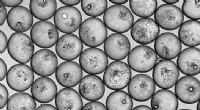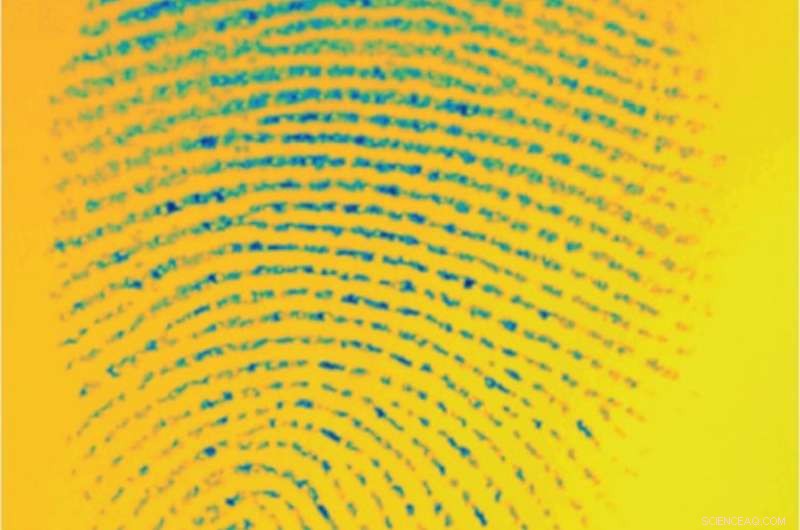
Small junctions between the fingerprint ridges and a smooth surface that grow and interconnect with increasing contact time. Credit: Brygida Dzidek.
(Phys.org)—A team of researchers from the University of Birmingham, Sorbonne Universités and Unilever Research & Development Port Sunlight, has found that human fingertips behave differently when touching something depending on the type of surface they touch. In their paper published in Proceedings of the National Academy of Sciences, the group describes experiments they conducted with volunteers and high-speed cameras and what they found.
Using our hands or just our fingers comes mostly naturally to most people. We tend to focus more on what we are trying to achieve rather than how it comes about. This is because nature has provided us with equipment that has some degree of autonomy. Our fingertips, as the researchers found, react automatically when we touch something, which offers the most possible benefit.
To learn more about how our fingertips work, the researchers asked two volunteers to touch and press different objects while the researchers filmed the action with a high-speed camera. They discovered that our fingertips secrete a very small amount of sweat when we touch something hard and smooth, like a pane of glass. The skin on the fingertips, they found, is rather hard in its natural state, but when we touch something, like a touch screen, the nerves in the fingers sense that hardness and sweat is produced. That sweat is then absorbed into the skin, softening it. This allows the hills of our fingerprints to yield to pressure, flattening a little, allowing more surface area contact. The whole process helps to handle hard surfaces in desirable ways—like holding onto a glass of water that would otherwise slip from our grasp. But, the team also found that it does not happen instantaneously—it took up to 20 seconds for the skin to soften, depending on factors such as the hardness of material and differences between people.
In contrast, the researchers found that when a fingertip comes into contact with something like a rubber surface, the flexibility of that surface conformed to the fingertips, reaching down into the valleys of our prints, and thus no softening of the skin was needed.
© 2017 Phys.org