1. Mass-Energy Equivalence:
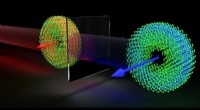
* Pair production is the creation of a particle-antiparticle pair (like an electron and positron) from pure energy, usually a high-energy photon.
* This process directly illustrates Einstein's famous equation E=mc², showcasing that energy can be converted into mass and vice versa.
2. Conservation of Energy and Momentum:
* The process of pair production must adhere to the laws of conservation of energy and momentum.
* The energy of the incoming photon must be at least equal to the rest mass energies of the produced particles (2 * 0.511 MeV for an electron-positron pair), plus their kinetic energy.
* Momentum must also be conserved, meaning the direction of the produced particles is related to the direction of the incoming photon.
3. Relativity of Simultaneity:
* Pair production can occur in different inertial frames, where observers will perceive the creation of the particles at different times due to the relativity of simultaneity.
* This demonstrates that the concept of absolute simultaneity is not valid in special relativity.
4. Time Dilation and Length Contraction:
* The energies and momenta of the produced particles in different inertial frames will be different due to time dilation and length contraction.
* These effects are consistent with the predictions of special relativity.
5. The Role of Invariant Quantities:
* Although the energy and momentum of the particles in pair production may vary in different frames, certain invariant quantities (like the four-momentum) remain constant.
* This highlights the importance of using four-vectors in special relativity.
In summary, pair production is a powerful example of the interplay between energy, mass, and momentum, illustrating the core tenets of special relativity. Its existence and behavior are essential to validating the theory and its implications for our understanding of the universe.