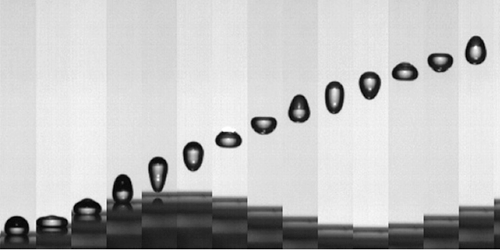
Credit: Physical Review Letters (2017). DOI: 10.1103/PhysRevLett.119.108001
(Phys.org)—A team of researchers with the University of Côte d'Azur in France has found that drops ejected by an oscillating surface can at times travel faster than the surface that ejected them. In their paper published in the journal Physical Review Letters, the team describes experiments they conducted by flinging water from a superhydrophobic surface and what they found.
If you place water on a bendable piece of vibrating plastic, the water droplets will be flung off into the air as the surface undulates. In this new effort, the researchers found that in some specific cases, some of those water droplets can actually travel faster into the air then the plastic base that pushed them. The researchers made this observation as they placed water drops onto a thin piece of plastic made of fluorinated polymers, which they note is similar to Teflon. The team then attached a device that vibrated the plastic at frequencies between 20 and 70Hz. As the oscillator was turned on, the researchers timed the speeds of the drops as they were flung into the air.
The group reports that the highest speed attained by the drops occurred at the halfway point to its peak, after which it slowed then fell back to the surface. But they also found that some of the droplets left the surface at roughly 1.6 times the speed of the rising surface.
To better understand what was occurring and why, the researchers took a closer look at the drop as it was being pushed off the surface. They found that it was squished slightly, like a tennis ball being hit by a racket. And like a tennis ball, the drop rebounded as it was being pushed off the surface. That rebound added to the release speed. The team describes the effect as superpropulsion. They found that the increase in speed of the drop was dependent on the size of the drop vibration compared to the oscillation frequency—the biggest gains came when the drop vibration frequency was approximately three times that of the surface's frequency. The researchers also compared the effect to the added lift a person gets on a trampoline when pushing at just the right moment.
© 2017 Phys.org